
Presbyterian minister and compiler of the 1723 Book of Constitutions · c. 1680 to 1739
Yes, James Anderson was a Freemason. A Scottish Presbyterian minister in London, he compiled The Constitutions of the Free-Masons (1723) at the direction of the premier Grand Lodge of England, and that year he was Master of Lodge No. 17 and Junior Grand Warden.
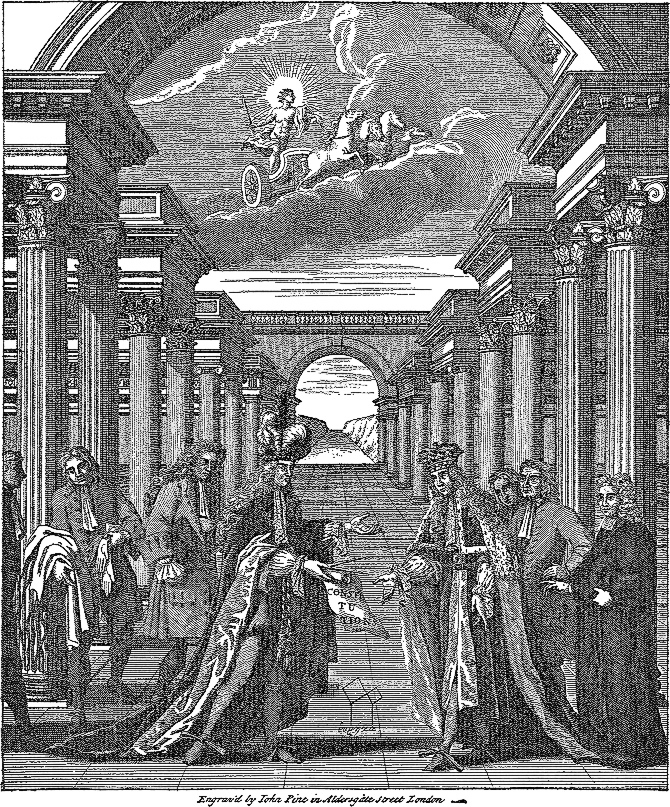
James Anderson (c. 1680–1739), a Scottish-born Presbyterian minister working in London, is inseparable from one of Freemasonry's most influential early printed books: The Constitutions of the Free-Masons (1723). Often called 'Anderson's Constitutions,' the volume drew together a traditional history of the Craft, regulations, obligations, and songs for the rapidly developing Grand Lodge in London. Anderson was a Mason and a Grand Lodge officer, but the book that bears his name was a collaborative institutional project. Reading it well means distinguishing his work as compiler from the contributions of other leaders—and distinguishing the book's legendary history from documentary evidence.
From Aberdeen to a London congregation
Anderson was born in Aberdeen around 1680 and educated at Marischal College. He later worked as minister of a Presbyterian congregation in London. A Scottish education, religious vocation, and life in the capital placed him among the literate networks through which early eighteenth-century intellectual and fraternal projects circulated. The 1723 Constitutions research project traces his role and the debates around it.
Anderson's Masonic membership is not in doubt, although his exact initiation and raising are unrecorded. By 1723 he was Master of a London lodge identified as Lodge No. 17 and had served as Junior Grand Warden of the Premier Grand Lodge. Those roles confirm that he was participating in lodge government rather than simply writing about a fraternity from the outside. The absence of a recorded initiation is not an invitation to invent a lodge or date.
What the 1723 Constitutions actually contained
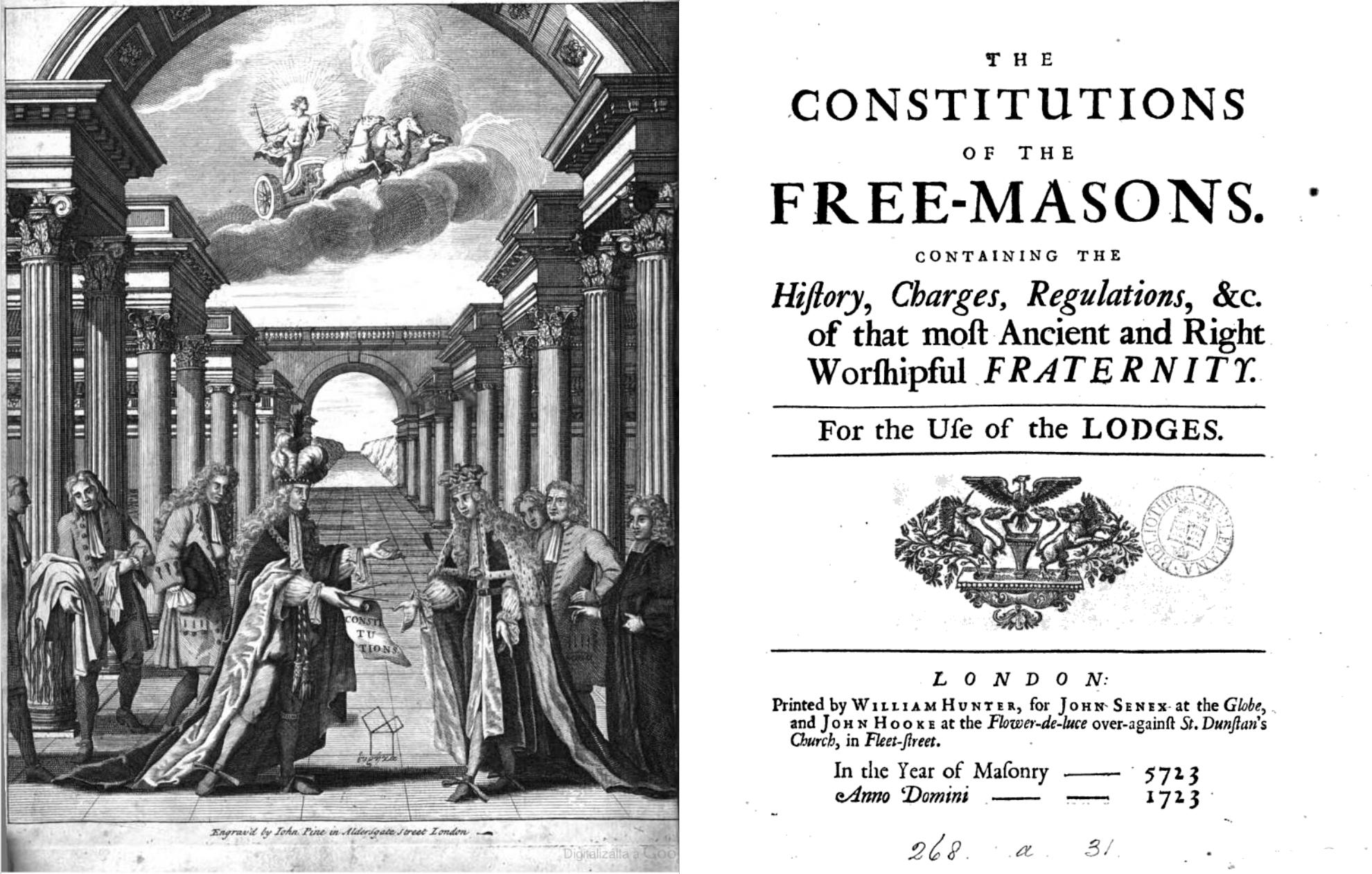
The book appeared in 1723, six years after the traditional date associated with the establishment of the Premier Grand Lodge in London. It was not a compact modern rulebook. It opened with a sweeping account of building and geometry, continued into the Charges of a Free-Mason, included General Regulations, and ended with songs and formal approvals. The United Grand Lodge of England's account explains the work's role as an early printed expression of the developing Grand Lodge's identity.
Its most startling pages present a history of Masonry reaching back toward the biblical beginning of the world. This was a literary and moral genealogy, influenced by the older 'Old Charges' manuscripts; it should not be read as proof that a continuous modern Masonic organization existed in Adam's time. The Scottish Rite Masonic Museum and Library explicitly draws attention to this legendary dimension. The book is historically precious because it reveals how eighteenth-century Masons explained themselves, not because every chronological claim in its ancient narrative can be verified.
The charges dealt with matters that remain recognizable: moral conduct, relations with civil authority, religious differences, behavior within a lodge, and relations among members. But even where the language sounds familiar, readers should avoid treating a 1723 formulation as a binding current regulation across all jurisdictions. Modern Masonic constitutions and ritual authorities vary by Grand Lodge, and later editions changed wording and emphasis.
The Library offers a cataloged 1723 edition of the Constitutions and another record of the early work. These make it possible to compare the primary text with later commentary. A scan should be identified by its exact edition and condition; a later facsimile or reprint is not a surviving original impression simply because it reproduces the same title page.
Was James Anderson the sole author?
Not in the simple modern sense of a solitary author producing every part. Anderson was asked to digest older constitutional materials into a new form, and his name became closely attached to the result. Yet the 1723 book incorporated regulations connected with the former Grand Master George Payne, was reviewed by a Grand Lodge committee, and drew on the work and influence of John Theophilus Desaguliers. The 1723 Constitutions authorship project cautions against equating the popular title with exclusive authorship.
The attribution of individual sections remains a subject of scholarship. A 2024 computational study of the book's authorship revisits the question through textual comparison. Its significance is not that statistical analysis instantly settles every disagreement, but that a familiar historical label can conceal editorial layers. The safest description is that Anderson was the credited compiler and a major contributor to a text approved through a broader Grand Lodge process.
The printed approvals and the work of publishers John Senex and John Hooke also remind us that a book is a material project. Manuscripts were reviewed, printed sheets were financed and distributed, and an organization chose to endorse what members would read. That collaborative mechanism helps explain why the Constitutions mattered: it turned several kinds of inherited practice and leadership preference into a publicly accessible statement.
A historical caution: London in 1717 was not the beginning of Masonry
Anderson's later history strongly shaped the familiar story that four London lodges organized a Grand Lodge in 1717. That is an important episode in the development of a particular English grand-lodge institution, but it should not be presented as the first time Masons met in lodges, or the first example of oversight among lodges anywhere. Scotland had surviving lodge records and forms of regional supervision that predated 1717, even though they were not styled in exactly the later English 'Grand Lodge' language. The exact institutional comparisons require care: a supervisory lodge and a sovereign Grand Lodge were not necessarily identical in authority or composition.
Equally important, Anderson wrote the fuller retrospective account of the 1717 events in his enlarged 1738 edition, rather than recording them as contemporaneous minutes from 1717. This distinction matters when assessing historical certainty. The site's history of the Premier Grand Lodge and explanation of territorial jurisdiction provide useful broader context for readers who want to understand how competing systems of Masonic authority developed.
The second edition and a surprising American connection
Anderson issued a substantially expanded edition of the Constitutions in 1738, the year before his death in London in 1739. The differences between 1723 and 1738 are significant to historians: wording was revised, material was added, and a more elaborate account of the early Grand Lodge took shape. When someone quotes 'Anderson's Constitutions,' asking which edition? is not pedantry. The answer can change the source and the historical claim being made.
There is also an American printing milestone. In 1734 Benjamin Franklin printed an edition of the Constitutions in Philadelphia—one of the important early bridges between London's Masonic print culture and the emerging American Craft. The UGLE history of the book identifies this transatlantic edition. A printer and a minister thus became linked across the Atlantic through the same institutional text, long before the American Grand Lodges of the nineteenth century began producing their own extensive systems of law and monitors.
How to approach Anderson today
For a modern Mason, Anderson is a gateway to early eighteenth-century ideals and institutional language. For a historian, he is a case study in how tradition, editorial work, political circumstances, and printing collaborated to construct an identity. His work should be read alongside Desaguliers, Payne, older manuscript charges, and Scottish archival evidence. It is neither an infallible history of antiquity nor an obsolete curiosity; it is a foundational source whose value grows when its layers and limitations are made visible.
Frequently asked questions
Was James Anderson a Freemason?
Yes. Anderson was Master of London Lodge No. 17 and Junior Grand Warden of the Premier Grand Lodge in 1723. The precise date and place of his initiation have not been securely established.
Did Anderson write every word of the 1723 Constitutions?
No exclusive authorship should be assumed. Anderson was its credited compiler, while George Payne, John Theophilus Desaguliers, reviewers, and the Grand Lodge approval process contributed to the finished book. Scholars continue to debate particular sections.
Is the 1723 Constitutions still the binding law of Freemasonry?
It is a foundational historical source, not a single universal modern constitution. Each recognized Grand Lodge regulates its own jurisdiction under its applicable laws. Readers should identify the edition being quoted and distinguish legendary narrative from documented history.
Explore the collection: Read more profiles and historical works in our Masonic Authors and Their Books guide, or browse the Works by Famous Masons Library collection.
Works cataloged in the Library
This catalog is linked to the Library's author record and displays the available works and editions automatically. Individual edition pages contain their own publication details.
In the library
Also in Masonic Scholars
Sources and references
See something wrong? Submit a correction.