
Wolfgang Amadeus Mozart · 1791
In this Viennese lodge cantata, individual voices step forward from a chorus singing of shared joy.
What to listen for
- The opening chorus.The opening words, Laut verkünde unsre Freude, call for joy to be proclaimed aloud. Listen first to the collective sound, then to what changes when individual voices step forward.
- Chorus and solo voices.Notice when the words become easier to pick out. Listen for how a single singer shapes a phrase differently from the assembled voices.
Lodge occasion
Written in 1791 for a Viennese lodge celebration, the cantata gives us a second example of Mozart writing for fellow Freemasons. Paired with the 1785 funeral music, it documents two very different occasions in lodge life.
A cantata for the dedication of a lodge room
Mozart entered the cantata in his catalogue on 15 November 1791. The brethren were dedicating new premises in Vienna, and the words give the singers something particular to celebrate. In the duet they address the walls themselves. A listener can imagine the effect in a newly occupied room: the building mentioned in the poem was the very place in which the words were being sung.
Accounts agree on the November dedication but give different performance dates. The Köchel catalogue lists 17 November; the Habsburg historical project gives 18 November. The date on the Library score, 1882, identifies the later Leipzig edition. Consult the Köchel entry and the Habsburg account of the dedication.
Follow the voices from chorus to duet
Find the first sung word
On the first score page, find the lines marked Tenore I, Tenore II and Basso. At first these singers have rests while flute, oboes, horns and strings set the music in motion. Move down to the second group of staves. Near its right edge, syllables finally appear beneath the vocal notes. Listen for that threshold. The opening sounds festive before anyone speaks, but the arrival of the word “Laut” turns the orchestral gesture into a public declaration.
Listen for speech, song and conversation
The cantata moves between recitative, aria, duet and chorus. Recitative follows the changing stresses of speech. An aria allows one singer to stay with an idea long enough for a melody to unfold. In the duet beginning “Lange sollen diese Mauern,” listen for the point where you can still distinguish two people but already hear a single phrase taking shape between them. When the opening chorus returns, the greeting now carries the memory of those individual voices. See the catalogue entry for the duet.
Read the words on the page
The 1882 edition credits Emanuel Schikaneder with the text, an attribution also given in the Köchel catalogue. Underlay is the name for the way the syllables sit beneath the notes. Pick one word sung by all three vocal lines and trace it vertically. Then read the same line horizontally to hear how Mozart stretches a syllable or lets the singers deliver several words in quick succession.
Follow the score
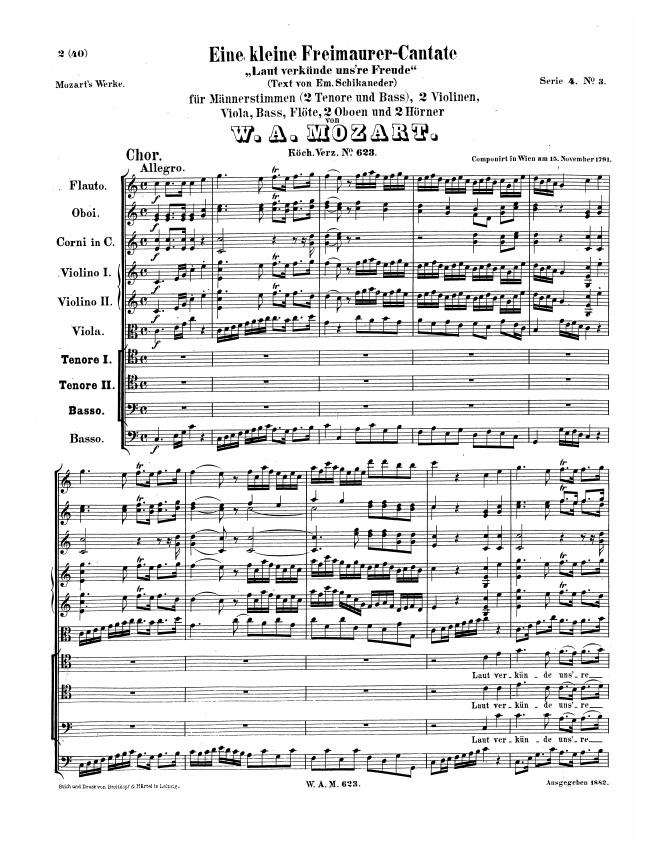 Read the full cantata score · 24 pages
The Library copy is the 1882 Breitkopf & Härtel edition from Leipzig. Look for the printed words beneath the vocal staves to follow the singers’ entries.
A question for discussion
Play the beginning immediately after the ending of the Funeral Music. How does adding an actual human voice change what it means to hear a group speak together?
Continue listening
Wolfgang Amadeus Mozart and Freemasonry · Mozart’s Masonic Funeral Music · Library cantata record