
At the Festive Board
A lodge banquet leaves several kinds of evidence. A printed menu can preserve a host, a hotel, or the names of speakers. A photograph shows how people occupied the room. A drinking vessel reveals what a guest could see at the table. These four records let us ask each kind of object a different question.
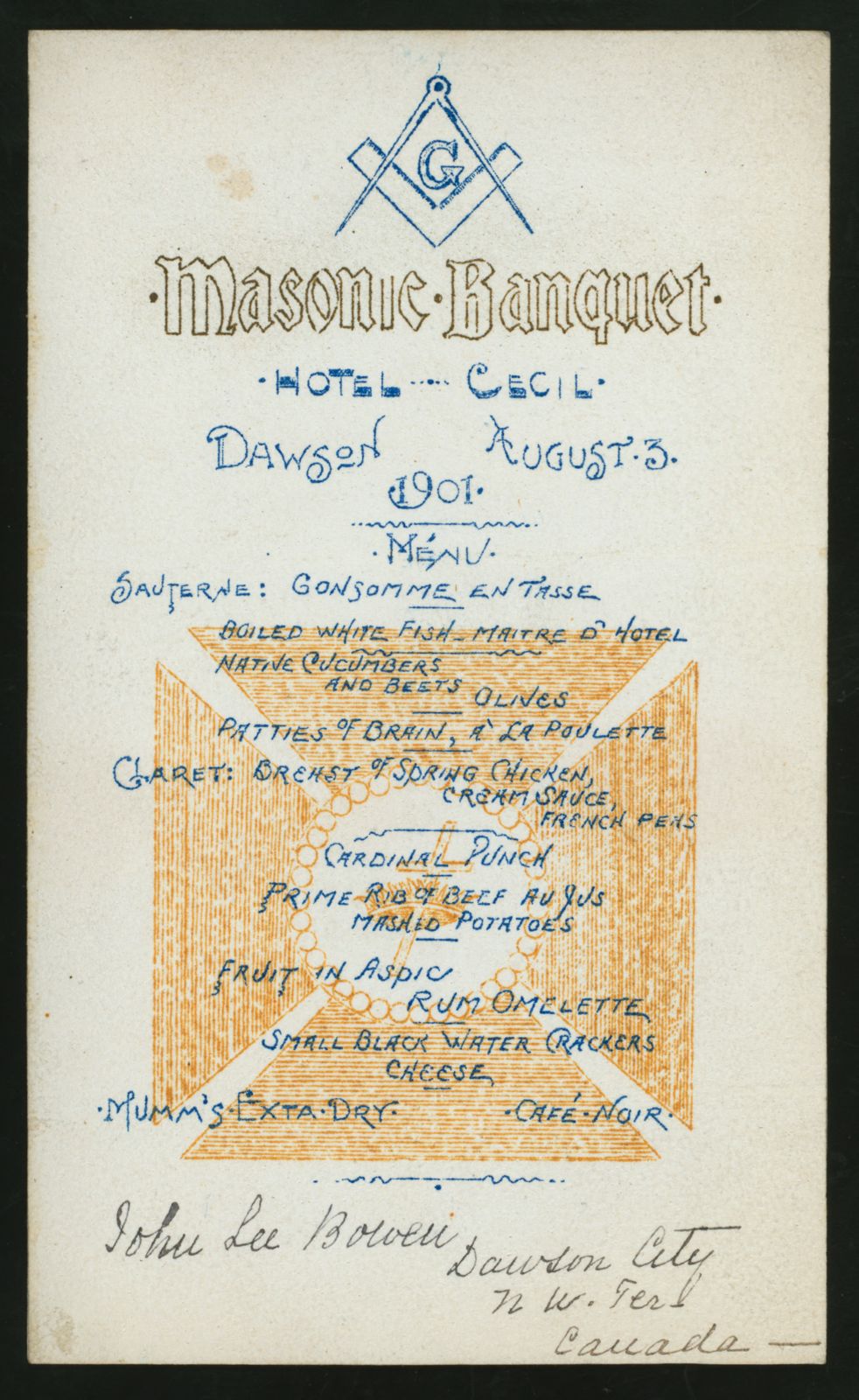
Image credits for Menu: banquet of the Masonic Society, Hotel Cecil, Dawson City, Yukon — Primary view
- Image
- Menu: banquet of the Masonic Society, Hotel Cecil, Dawson City, Yukon — Primary view
- Holding institution
- New York Public Library
- Credit
- From The New York Public Library
- Source
- View source record
- Image rights
- Public domain (NYPL Digital Collections)
Read the guest’s copy
At the Hotel Cecil in Dawson City, Yukon, the Masonic Society marked its 1901 banquet with a printed menu. The New York Public Library records green ink, a Masonic emblem, and a handwritten name and address. The handwriting gives this particular copy a history beyond the printed occasion.
Menu: banquet of the Masonic Society, Hotel Cecil, Dawson City, Yukon
Look beyond the meal
Another 1901 menu, for the Seventh Masonic District at the Marlborough Hotel, lists speakers. It preserves part of the evening’s program as well as its setting. The library leaves the city uncertain, a useful reminder of what a named hotel alone can establish.
Menu: banquet of the Seventh Masonic District, Marlborough Hotel
Step back from the table
In Indianapolis on May 19, 1915, a panorama captured the Scottish Rite Golden Jubilee banquet. Follow the long tables beneath the flags and bunting. The picture records the scale and arrangement of the celebration; a single guest’s menu could scarcely convey either.
Turn the vessel
The printed design continues around this Worcester mug. Use the gallery views to follow the marks across its curved surface. The mug is an earlier example of Masonic tableware. Its record gives no connection to the three banquets above.