
Wolfgang Amadeus Mozart · 1787
In this serenade for strings, a bold opening call gives way to a quieter answer.
What to listen for
- The opening call.The opening leaps upward in unison. Try singing its outline after a single hearing. Then follow the quieter answer that gives the phrase a sense of balance.
- Melody and bass.Follow the lowest string line when the violins carry the tune. When does the bass reinforce their rhythm, and when does it give the melody something to push against?
Serenade history
This 1787 serenade offers a way into Mozart’s writing for strings. Its first movement makes a whole ensemble sound like a single player before dividing the musical argument among the parts. Its place in this collection comes through Mozart’s membership in Viennese Freemasonry. The serenade gives listeners a point of comparison with his music for lodge occasions.
The missing minuet and the work Mozart described
Mozart entered this work in his catalogue in Vienna on 10 August 1787. His description names five movements. Most audiences hear four. Between the opening Allegro and the Romance he listed a minuet and trio whose music is lost. The minuet heard today comes after the Romance and is the second dance in his original plan.
The Mozarteum connects the loss with the physical construction of the manuscript. Mozart removed a leaf containing an earlier slow movement. The other half of that folded sheet, carrying the first minuet, came loose. The exact occasion for the piece is also unknown. Its title suggests evening music, but identifying a particular household or lodge as its first audience would go beyond the evidence. Read the Mozarteum’s account of the manuscript.
A listening map for the four surviving movements
I. Allegro
The embedded performance covers this movement. At the opening, the strings launch the same sharply outlined idea together. Listen to where they stop. The silence cuts the gesture into a shape you can remember. Later, listen for its return and ask whether you recognize the pitches first or the combination of attack, pause and answer.
II. Romance
The slower movement trades the opening challenge for a melody that can be sung in a single breath. Hold its first phrase in memory while the intervening music grows more agitated. Its return is especially easy to recognize if you follow the accompaniment as well as the tune.
III. Menuetto and Trio
Count in threes through the minuet. Notice how firmly the opening weights the first beat, then compare the lighter articulation in the trio. “Trio” here names the contrasting middle section of the dance. When the minuet comes back, the change in character can be heard even before the opening phrase is complete.
IV. Rondo
The finale restores the quick pace. Listen for a familiar idea finding its way back after an excursion. For a different experience, give your attention to the lower strings as the return approaches: a change in their direction can make you expect home before the violins have announced it.
From string players to two pianists
Mozart’s scoring has two violin parts, viola, cello and bass. The edition pictured here names Otto Singer as arranger for piano four hands. Two players share one keyboard. The higher part can make a violin melody easy to pick out; the lower part lets a pianist feel the bass rhythm under the same phrase. What the keyboard cannot sustain in quite the same way is the changing pressure of several bows on a long note. Compare the opening in the score with the first few seconds of the recording and listen for that difference.
The work’s familiarity came much later. The Mozarteum dates its first printing to about 1837 and credits twentieth-century broadcasting and recordings with its extraordinary reach. Singer’s arrangement offers another way into that history: a domestic keyboard could bring the ensemble’s parts into a room occupied by just two players. Explore the publication and reception history.
Follow the score
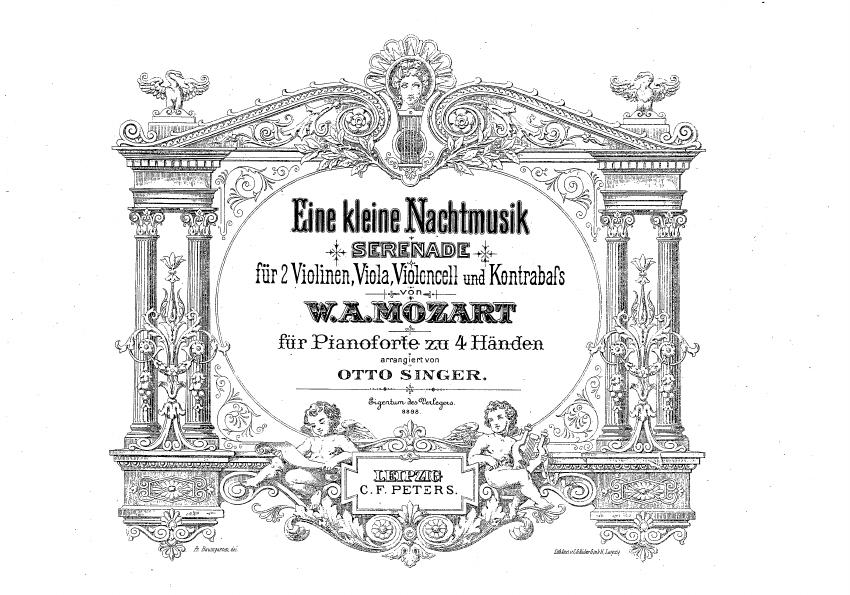 Read the full four-hand score · 24 pages
The 24-page reading copy is an arrangement for piano four hands. Follow the rhythm of the opening across the keyboard parts. For the original string instrumentation, choose a complete orchestral score from the IMSLP editions below.
Read the four-hand score · 24 pages · Compare score editions on IMSLP
A question for discussion
How much of the opening phrase can you recognize from its rhythm alone? Tap it, then listen again for the shape supplied by the pitches.
Continue listening
Wolfgang Amadeus Mozart and Freemasonry · Mozart’s Masonic Funeral Music