
Draw a one-page map for a guest attending a lodge open house. Test it with a first-time reader, revise the confusing turn, and publish a usable map key.
Start at the point of arrival
Picture a first-time guest arriving for an open house shortly before dinner. They know the lodge’s name and street address. They need to identify the guest parking area, find the correct door and recognize it when they arrive. Walk the approach yourself and record what a guest can actually see at each turn.
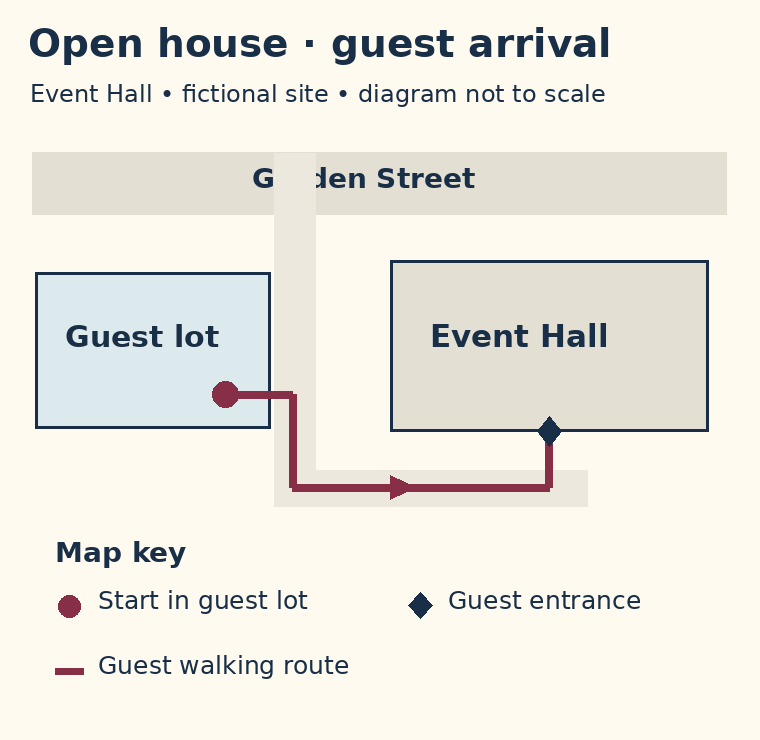
Make a first draft from verified observations
- Choose the boundary
- Include the approach street, lot, building outline, entrance and the turns connecting them. A nearby landmark can help a guest orient the sheet. Leave out rooms, parcels and service areas that add no wayfinding value.
- Build the key while you draw
- Use a dot for arrival, a diamond for the guest door and a high-contrast line with a directional arrow for the walking route. Repeat those actual samples in the key. Mark the building with a name as well as a shape.
- State what the drawing can support
- For a schematic, print “not to scale.” For a measured map, supply a verified scale bar. Label the arrival street. If you show north, verify its direction. Confirm any designated accessible entrance or step-free route with the venue before marking it.
- Add a text route
- Give the street, starting feature, turns and destination in words. Describe stable landmarks. Name the entrance in the same words used on the event invitation and on-site signs. Record the venue or source and the date checked.
Test the map like a first-time guest
Hand it to someone who has never been to the venue. Without prompting, ask them to mark the start, trace the route and point to the door. Note their first hesitation. If they mistake the nearest street-facing wall for the entrance, move the door label closer to the marked door and strengthen the final turn. Test the revision with a second person.
Open the draft at phone width and print a grayscale copy. Read the street and door labels without zooming if possible. Check that line and point shapes remain distinguishable without color. For online publication, include the text route alongside the image so a visitor can follow it with a screen reader or copy it into an event reminder.
Try the example
A reader points to the right building but the wrong wall. What single change would you test first, and how would you know it helped?
Check your answer
Put a distinct entrance mark directly on the correct wall and label it with the door name used on site. Ask a new reader to trace the last turn and identify the entrance without a hint. Recheck the text directions against that same route.
Practice on your own
Deliver a single-page visitor map, its legend, a short text route and one before-and-after note from the reader test. A guest should be able to identify the starting place, every decision point and the correct door.