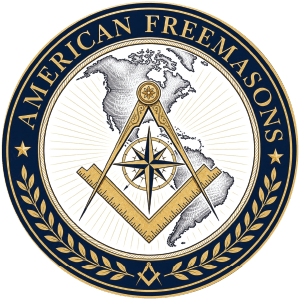
The square and compasses is the chief emblem of Freemasonry, a builder’s square joined with a pair of compasses, and it teaches two lessons at once: to square one’s actions by the rule of right conduct, and to keep one’s desires within due bounds. The Masonic square and compass, as it is often written, is the most recognized symbol of the Craft, found on rings, aprons, and the fronts of lodge buildings, and in most American lodges it carries the letter G at its center. This guide explains what the emblem means, what each tool teaches, and why its arrangement changes from one degree to the next.
At a Glance
- Also written
- The square and compass, in some jurisdictions
- The square
- Squaring one’s actions by right conduct
- The compasses
- Keeping one’s desires within due bounds
- The letter G
- Geometry and God, the Grand Architect of the Universe
- On the altar
- One of the Three Great Lights, with the Volume of the Sacred Law
- Varies
- Some lodges show the emblem without the G
◆What the Square and Compasses Means
The square and compasses is the chief emblem of Freemasonry, built from two tools of the stonemason’s trade and turned to moral instruction. Taken together, the two stand for the balance of a well-ordered life: the discipline to act justly toward others, and the self-command to govern one’s own desires. It is the most widely recognized sign of the Craft, and to deal honestly is still spoken of, inside the lodge and out, as acting on the square. Both tools are far older than the fraternity that adopted them, carried for centuries by the working masons whose craft speculative Freemasonry took as its model.
The emblem belongs to the wider language of Masonic symbols, where a builder’s tool is given a meaning a member can carry into daily life. The same square and compasses is used across mainstream and Prince Hall lodges alike, and while its exact look varies a little between jurisdictions, every Freemason reads it the same way.
◆The Square
The square is the emblem of morality and honest dealing. In the stonemason’s trade it was the tool that tested a true right angle, proving that a stone’s edges were cut straight and would sit square in the wall. Freemasonry takes that plain function and makes it a rule of life: a Mason is taught to square his actions by the square of virtue, and to deal fairly and truthfully with all people. The square is also the working tool that belongs to the Fellowcraft and the jewel worn by the Master of the lodge, a reminder that the man who leads is held to the same straight standard he asks of others.
The Square
Tests a true right angle. The emblem of morality and honest dealing.
The Compasses
Draws and bounds a circle. The emblem of self-restraint.
◆The Compasses
The compasses teach a Mason to circumscribe his desires and keep his passions within due bounds. In the craft of building, the compasses drew circles and stepped off exact measurements; in the lodge they stand for the self-restraint that keeps a good man from excess. Where the square governs how a Mason acts toward others, the compasses govern how he governs himself. In the third degree the points of the compasses are tied to the chief tenets of the Craft, brotherly love, relief, and truth, the qualities a Master Mason is charged to hold closest.
The two tools are meant to be read together. The square looks outward, to a man’s dealings with the world; the compasses look inward, to the government of his own heart. A life lived by both is the plain ideal the emblem holds up, neither rigid nor unrestrained, but measured. It is for this reason that the square and compasses, more than any single tool, came to stand for the whole of the Craft.
◆The Letter G
At the center of the emblem, in most American lodges, sits the letter G, and it carries two meanings at once. The first is geometry, the science on which the building art rests and, to the Mason, the ordered design running through all creation. The second is God, addressed in the lodge as the Grand Architect of the Universe. That a single English letter opens both words is treated as a fitting coincidence rather than a hidden code. Not every jurisdiction uses it: many lodges outside the United States, including those under the English constitution, show the square and compasses without the G, placing the letter elsewhere in the lodge or leaving it out altogether.
◆How It Is Arranged
On the altar of a lodge the square and compasses rest upon the Volume of the Sacred Law, and together the three form what Freemasonry calls the Three Great Lights. The way the compasses are set over or under the square is not decoration; it marks which degree the lodge is working, and a Mason learns to read it at a glance.
In the customary arrangement, the Entered Apprentice sees both points of the compasses hidden beneath the square, a sign that he stands only at the beginning of the work. In the Fellowcraft degree one point is raised above the square, and in the Master Mason degree both points are shown above it, the compasses fully overlying the square. Because the change is small and easily missed, it is one of the first details an attentive member is taught to notice. The arrangement varies between jurisdictions, but the progression it pictures, from concealment to revelation, is the same wherever it is kept.
In Short
- The square and compasses is the chief emblem of Freemasonry, joining a builder’s square with a pair of compasses.
- The square teaches a Mason to square his actions by right conduct; the compasses, to keep his desires within due bounds.
- The letter G at the center stands for both geometry and God, the Grand Architect, though some jurisdictions show the emblem without it.
- The way the compasses sit over or under the square marks the degree the lodge is working.
◆Frequently Asked Questions
01What does the square and compasses mean?
The square stands for morality and honest dealing, and the compasses for self-restraint, keeping one’s desires within due bounds. Together they represent the balance of conduct and conscience in a well-ordered life.
02What does the letter G stand for?
It carries two meanings at once: geometry, the science behind the building art, and God, addressed in the lodge as the Grand Architect of the Universe. Some jurisdictions show the emblem without it.
03Is it square and compass or square and compasses?
Both are used for the same emblem. Square and compasses, in the plural, is the older Masonic form, while square and compass is common in everyday speech and in some jurisdictions.
04Why does the arrangement change between degrees?
The position of the compasses over or under the square marks the degree the lodge is working: both points hidden for the Entered Apprentice, one point raised for the Fellowcraft, and both points shown for the Master Mason.
05Are the square and compasses religious?
Freemasonry requires a belief in a Supreme Being but leaves its name and form to each member, so the emblem serves men of different faiths. The question is taken up in our guide to whether Freemasonry is a religion.
Sources & References
- United Grand Lodge of England, on Freemasonry and its symbols.
- Grand Lodge of Maine, handbook for Masons on the Great Lights and the letter G.
- Grand Lodge of British Columbia and Yukon, reference articles on Masonic symbolism.
- Scottish Rite, NMJ, on the square, the compasses, and the working tools.
- Encyclopaedia Britannica, Freemasonry.
The meaning of each part of this emblem is drawn from mainstream Masonic reference works and grand lodge sources, and ritual details are described as customary, with jurisdictional variation noted. Spotted an error? Submit a correction, or read our editorial standards.