
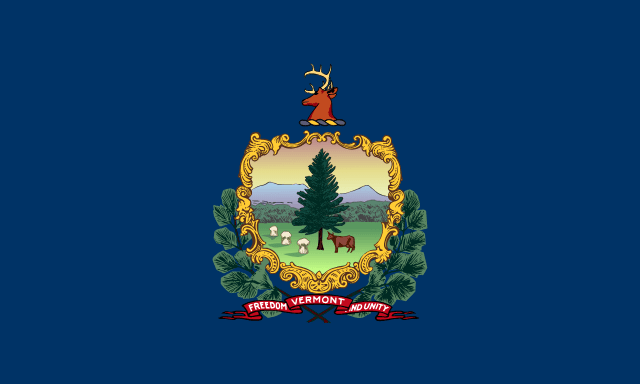
The Grand Lodge That Opened and Closed Itself
Vermont was the heart of the Anti-Masonic movement, and its grand lodge came closer to extinction than any other in the country. For most of a decade three officers met each year to declare the Grand Lodge open and then immediately closed, keeping it in existence until the lodges could be revived.
Mainstream
Grand Lodge of Vermont, F. & A.M.
Founded and chartered in 1794, three years after Freemasonry reached the state and three years after Vermont joined the Union. Seated at 49 East Road, Barre. Recognized by the United Grand Lodge of England.
It works some eighty-five lodges from North Troy and Swanton in the north to Brattleboro and Bennington in the south, and is recognized by the State of Vermont as the oldest continuously active not-for-profit organization in the state.
Prince Hall Affiliated
None found
No Prince Hall grand lodge is seated in Vermont, and we have not identified any out-of-state Prince Hall jurisdiction that claims it. Vermont does not appear in the list of lodges held outside Massachusetts by the Prince Hall Grand Lodge of Massachusetts, which does name Bangor in Maine and Portsmouth in New Hampshire.
This page reports that as a finding of searching rather than as a settled fact, and would be glad to be corrected.
The Anti-Masonic years nearly ended Freemasonry here. Lodges dissolved and their funds were given to the Common School Fund of Vermont. From 1837 the Grand Lodge consisted in practice of three men: Grand Master Haswell, Grand Treasurer Englesby and Grand Secretary Hollenbach, who met, declared the Grand Lodge open, and declared it closed. They did the same in 1838, 1840, 1842 and 1844. In 1846 Haswell invited the ten surviving lodges to meet, and with Deputy Grand Master Philip Tucker he brought the Grand Lodge back into working order. New charters were issued to every surviving lodge in 1849. There were thirty-five lodges by 1856 and a hundred by 1873.
Vermont has one direct connection to Prince Hall history, and it is a substantial one. When the legitimacy of the Prince Hall charters was disputed in the nineteenth century, the investigation that Mackey’s Encyclopaedia of Freemasonry relied on was carried out by two men: Charles W. Moore of Massachusetts and Philip S. Tucker of Vermont, the same Deputy Grand Master who helped restore the Vermont grand lodge after the Anti-Masonic collapse.
Explore the Vermont Masonic collections, including state outline gear, Freemasons wordmarks, and The Sugarhouse Drawknife.
Recognition status: United Grand Lodge of England, Foreign Grand Lodges, which lists the Grand Lodge of Vermont and lists no Prince Hall grand lodge for the state. Founding of 1794, the seat at 49 East Road, Barre, the lodge count and the standing as the oldest continuously active not-for-profit organization in Vermont: Grand Lodge of Vermont, and the George Washington Masonic National Memorial. The Anti-Masonic years, the annual opening and closing of the Grand Lodge from 1837, the revival of 1846 under Haswell and Tucker, the new charters of 1849 and the lodge counts of 1856 and 1873: the same Memorial feature. Philip S. Tucker and Charles W. Moore as the investigators of the origins of Prince Hall Freemasonry: Mackey, Encyclopaedia of Freemasonry, under Negro Lodges. Consulted August 11, 2026. The absence of a Prince Hall jurisdiction covering Vermont is reported as the result of searching and is not asserted as established. State outline simplified from Natural Earth public domain boundary data.