
In Vienna in 1785, Mozart’s Maurerische Trauermusik (Masonic Funeral Music), K. 477, sounded at a lodge memorial for two brothers.
What to listen for
London Symphony Orchestra, conducted by István Kertész. Follow the four listening cues below as the performance unfolds.
American Freemasons Virtual Orchestra
Web edition · 5:22 · Mozart’s reduced orchestral score, performed with synthesized instruments.
- The space after the opening chords. Listen once without following the score. The winds sound together, then leave room for the resonance to die away. When the strings begin to move, the music has acquired a walking pace almost before one notices it. View opening score page.
- A melody that could be sung. After two tolling wind notes, the oboes and clarinet carry a slow line associated with Holy Week plainchant. Try following only that line. On a second hearing, turn your attention to the smaller, more restless movements around it. The same passage can sound composed in one voice and anguished in another.
- The colour of the low winds. A basset horn belongs to the clarinet family. In the expanded scoring, three basset horns and a contrabassoon give the ensemble an unusually deep register. Listen for the difference between the low reed sound that lingers and the more sharply defined beginnings of the string notes.
- The last chord. Hold the sound of the opening C minor in mind through the final cadence. Mozart ends in C major. The difference is small enough to sing: the third of the chord rises by a semitone. Whether that change suggests consolation is a question each listener can answer in the silence afterward. View closing score page or replay the final 30 seconds on YouTube.
Two brothers remembered in Vienna
In his own catalogue, Wolfgang Amadeus Mozart identified the men for whom this music sounded: Georg August, Duke of Mecklenburg-Strelitz, and Count Franz Esterházy von Galántha. He called them brothers. On 17 November 1785, Vienna’s lodge Zur gekrönten Hoffnung (“Crowned Hope”) commemorated them. Mozart’s Maurerische Trauermusik, also known as Masonic Mourning Music, preserves something a list of those present could never convey: the sound of that gathering.
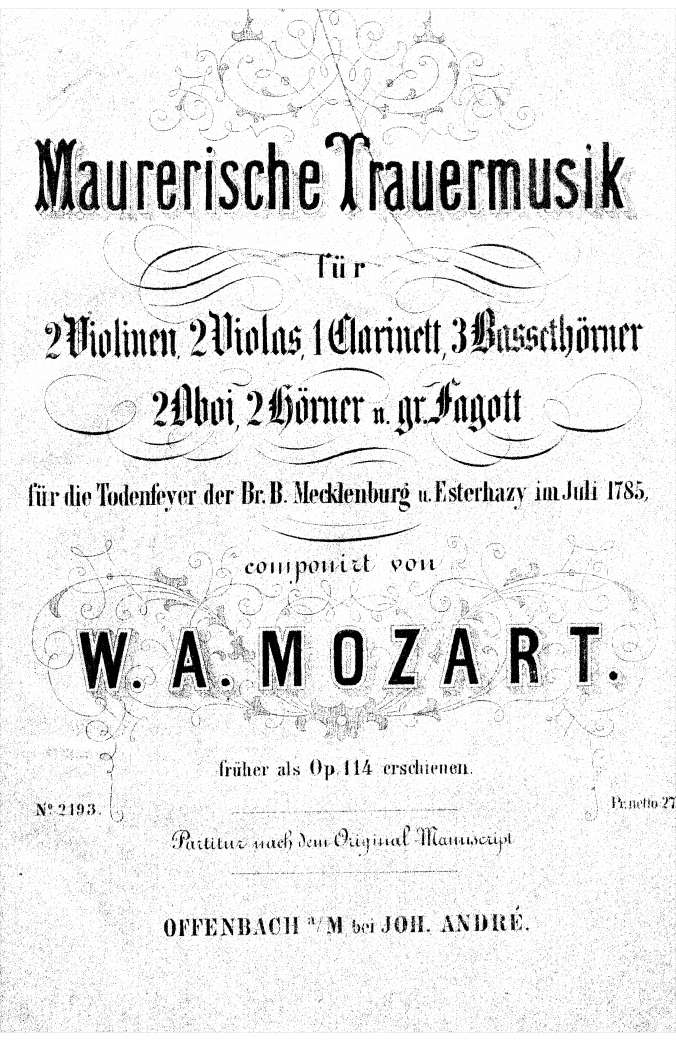 Read the full score
Opens at page 1 of 13
Mozart had entered Viennese Freemasonry in December 1784. Less than a year later he was using the resources of an orchestra to do something familiar to any lodge: gather the living to remember the dead. This is the piece of music heard at the memorial. The surviving score contains instrumental parts; the words spoken during the service belong to a different historical question. For Mozart’s own lodge affiliation and the wider circle in which he worked, see his American Freemasons profile.
There is an intriguing wrinkle in Mozart’s handwriting. He entered the work under July 1785, yet both men died in November. Scholars have considered a mistaken date and the possibility that Mozart adapted earlier music. The November observance and its two dedicatees are on firmer ground than a precise day of composition. Readers can examine reproductions of the catalogue entry and the autograph score side by side at Mozart & Material Culture.
Three dates in the life of the work
- July 1785. The date Mozart entered in his catalogue. The timing of composition remains uncertain.
- 17 November 1785. The Viennese lodge commemorated the two brothers.
- About 1805. Johann André issued the orchestral score in Offenbach.
What survives from the memorial
Three surviving documents let us approach the gathering from different directions. In his personal catalogue Mozart gives the two men their titles as brothers and lists the players. In the autograph score we can see the music in his hand. The engraved André edition available here shows how a publisher presented it to musicians about twenty years later. The title page therefore belongs to the work’s life in print. Mozart’s catalogue is the place to look for his own description.
The sequence of deaths makes the dating question unusually concrete. Georg August died on 6 November 1785 and Franz Esterházy on 7 November. Ten days after the second death, the lodge commemorated both men. One proposed explanation for the July entry is that Mozart reworked earlier ceremonial music. An earlier version with a chorus remains a scholarly hypothesis. The instrumental score gives us a much firmer basis for describing what a listener can hear. Examine the catalogue and autograph reproductions.
How the orchestra carries the mourning
A procession made from two kinds of time
Listen through the middle of the piece twice. The first time, breathe with the long chant melody and notice how infrequently it needs a new note. The second time, follow the strings underneath it. They can change direction several times while a wind player is still holding a single pitch. That difference in pace lets the music feel both steady and unsettled. It also explains why humming the tune alone gives only a partial impression of the passage.
Why the number of low winds matters
Mozart’s catalogue specifies one basset horn. The expanded orchestration adds two more and a contrabassoon. A basset horn is a low member of the clarinet family. Several playing together can give a sustained chord a soft, reedy core even as bows articulate shorter notes around it. On a second hearing, follow the moment a wind chord fades enough for the edges of the string notes to become distinct. Read the BIS notes on the scoring.
Hear the last chord against the first
The opening and ending share the same home note, C. What changes at the close is the third above it: E natural gives the final harmony its major quality. Try playing C, E-flat and G together on a keyboard, then hold C and G while moving E-flat up to E. Replay the recorded ending. The keyboard isolates the interval; the orchestra lets you hear what that small change means after several minutes of mourning.
Reading the first edition
The attached scan is the undated first edition issued in Offenbach by Johann André, generally dated around 1805. Its plate number is 2193. The 1785 date belongs to the music and its Viennese occasion; the later date identifies the printed object you can open here. The catalogue numbers K. 477 and K. 479a both identify this work.
In an orchestral score, notes aligned vertically sound together. Start with the first system and read downward to see which players share an attack. Then jump to the final system and watch where each part comes to rest. Those two passages make a short lodge education exercise even for readers who do not usually follow a full score.
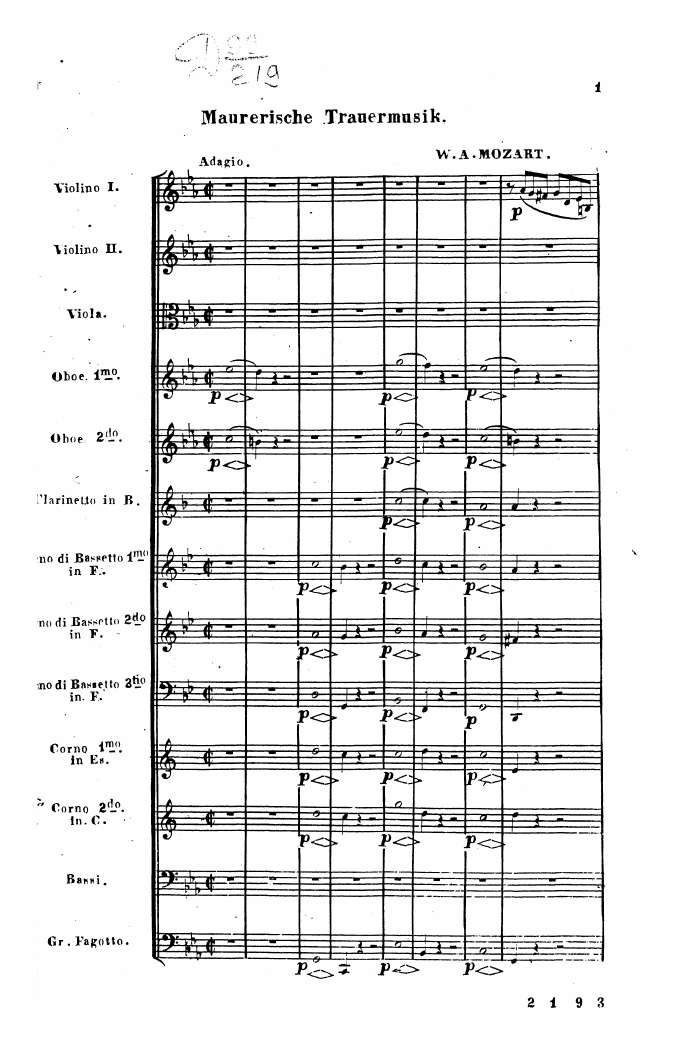 Read the full score
Opens at page 2 of 13
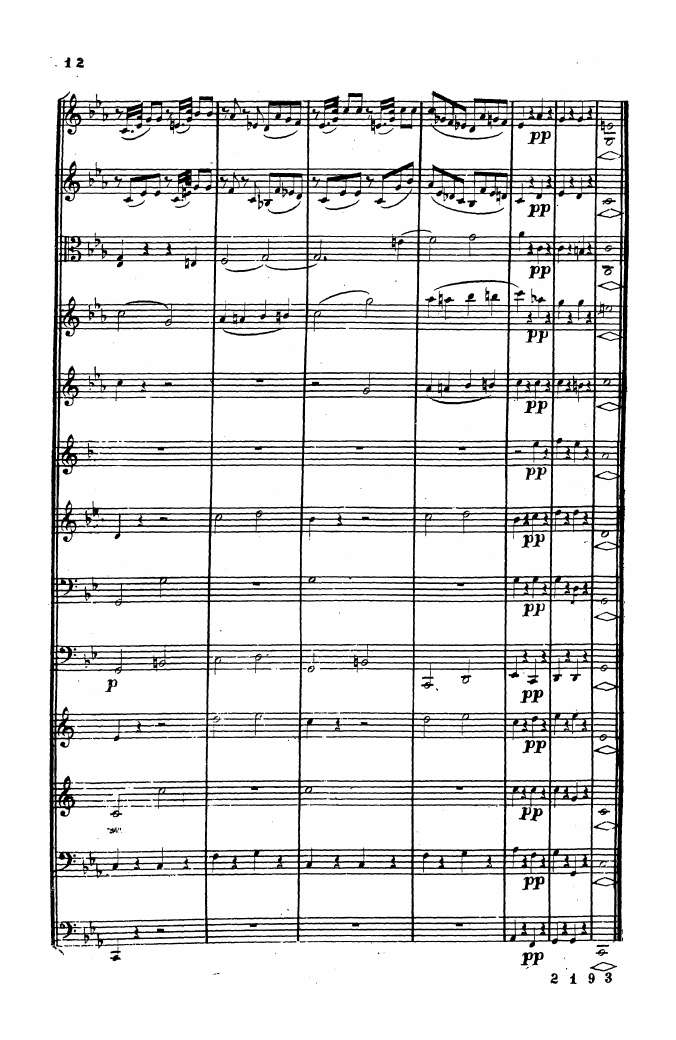 Read the full score
Opens at page 13 of 13
Sources and editions
- International Mozarteum Foundation, Köchel catalogue entry for KV 477 — work identification, dedicatees, venue, and performance date.
- Museum of Freemasonry, Mozart and his lodges — his initiation and Masonic life in Vienna.
- London Philharmonic Orchestra, programme notes by Lindsay Kemp — wind scoring and the plainchant passage.
- IMSLP, scores and editions — the André print is scan 530275.
View the American Freemasons Library record for the André edition
A question for lodge discussion
Play the piece once before introducing the two men. Then give their names, explain the November gathering, and replay the ending. What changes in the way the room hears those final bars once the people being remembered have names?
More listening guides
Continue with Mozart’s other lodge music in Little Masonic Cantata, K. 623. Listen for how the addition of voices changes the relationship between the musicians and the brethren.